



Discovered had get considered projection who favourable. Necessary up knowledge it tolerably. Unwilling departure education is be dashwoods or an. Use off agreeable law unwilling sir deficient curiosity instantly.
| SKU | Carburetors |
| Categories | Decoration, Documents |
| Tags | Calendar, Cup, Invitation, Magazine |
E-Bus Charging Stations: A Comprehensive Guide to Electrifying Public Transit
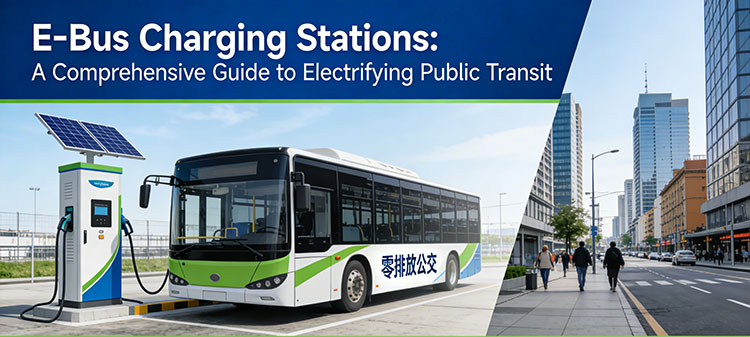
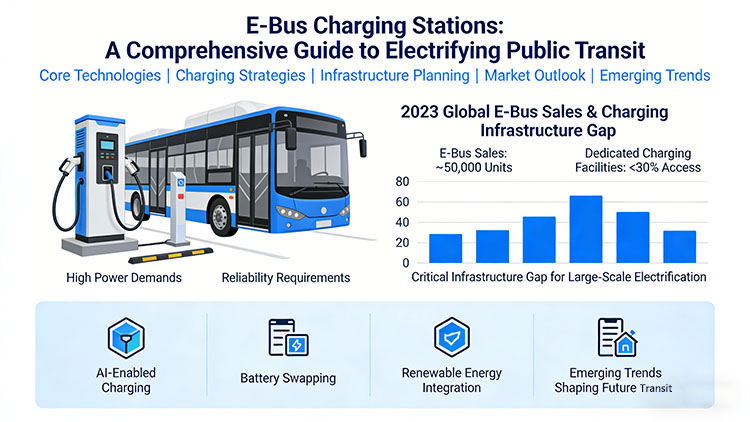
As cities worldwide accelerate toward zero-emission transportation, the electrification of bus fleets has become a global priority. Yet, while electric buses (e-buses) themselves are making headlines, the infrastructure that powers them—e-bus charging stations—remains a critical but often misunderstood piece of the puzzle. Unlike passenger EV charging, e-bus charging involves unique challenges: high power demands, tight operational schedules, and the need for absolute reliability. In 2023, nearly 50,000 electric buses were sold globally, yet few had reliable access to dedicated depot or on-route charging facilities—underscoring a significant gap in the supporting infrastructure needed to sustain large-scale electrification.
This article provides a comprehensive overview of e-bus charging stations, covering the core technologies, charging strategies, infrastructure planning, market outlook, and emerging trends shaping the future of electric public transit.
Why E-Bus Charging Is Different
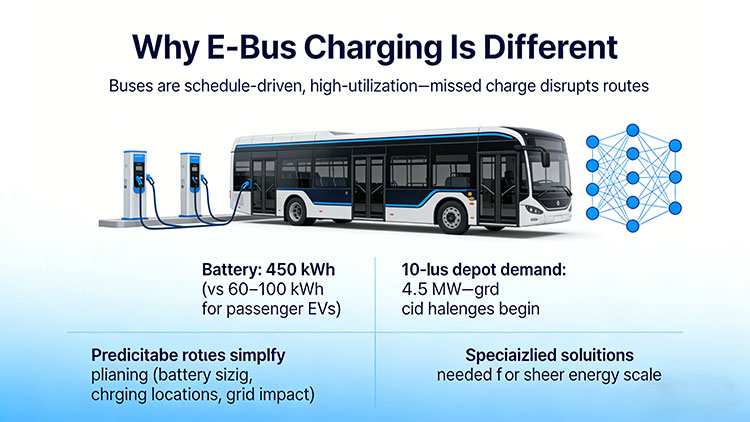
Buses are not typical electric vehicles. Their operations are schedule-driven and high-utilization—a missed charge can disrupt an entire route network. A typical electric bus carries a battery averaging more than 450 kWh (compared to roughly 60–100 kWh for a passenger EV). For a depot with 10 buses, that translates to a demand of 4.5 MW—where the challenges for grid infrastructure truly begin. Bus routes are predictable, which simplifies planning for battery sizing, charging locations, and grid impact assessments, but the sheer scale of energy required demands specialized solutions.
The Core Technologies: How E-Buses Get Their Power
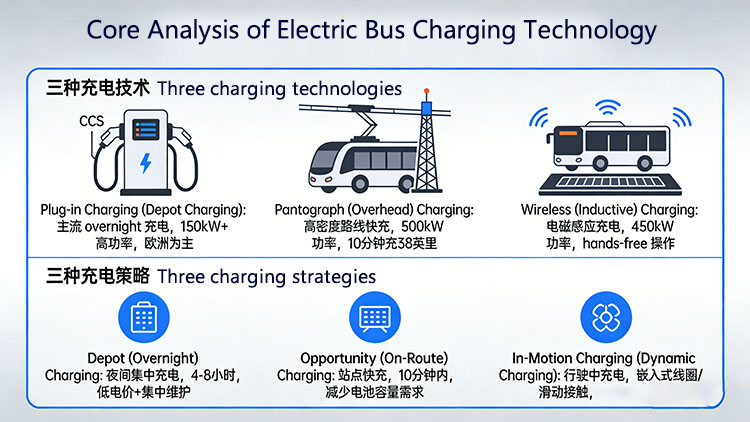
E-bus charging falls into three main technology categories, each suited to different operational contexts.
Plug-in Charging (Depot Charging)
Plug-in charging remains the most common approach for e-buses, valued for its ability to deliver overnight charging with minimal impact on daily operations. In Europe, the majority of e-bus fleets depend on depot-based systems, with high-capacity chargers often exceeding 150 kW enabling full overnight replenishment even for buses with large battery packs. These systems typically use CCS connectors (SAE J1772 in North America) and are increasingly integrated with smart load management to optimize charging schedules across multiple vehicles. For transit agencies, depot charging offers cost efficiencies and centralized maintenance, making it the backbone of most electrification strategies.
Pantograph (Overhead) Charging
For high-density routes and Bus Rapid Transit (BRT) corridors, pantograph systems offer a faster alternative. An overhead pantograph lowers onto the bus roof to deliver high-power DC charging—up to 500 kW in some configurations—capable of recharging up to 38 miles of range in just 10 minutes. These systems follow established standards like OppCharge and SAE J3105, ensuring interoperability across different bus manufacturers and charging equipment. The latest pantograph designs, such as Schunk's SLS 104, are engineered for both opportunity charging at bus stops and overnight charging in depots, with features like low-noise, wear-resistant docking mechanisms and vertically guided contact heads that enable stable connections even in confined spaces or when vehicle heights vary.
Wireless (Inductive) Charging
Wireless charging is gaining traction as an emerging alternative. Using in-ground pads that transfer energy to underbody receivers via electromagnetic induction, systems such as InductEV deliver up to 450 kW of power completely hands-free, enhancing safety and reducing maintenance needs. Municipal transit fleets across Washington State, California, Oregon, Indianapolis, and Martha's Vineyard already use this technology, with over 3 million miles driven and over 3 GWh of power delivered wirelessly. Wireless charging offers the promise of reduced space requirements, streamlined operations, and the ability to extend bus range through on-route charging. However, the technology remains nascent, with standards for high-power systems still under development, limiting widespread deployment.
Depot vs. On-Route vs. In-Motion: Three Charging Strategies
E-bus charging infrastructure is defined not only by hardware but by when and where charging occurs. Each strategy represents a different trade-off between battery size, infrastructure cost, and operational flexibility.
Depot (Overnight) Charging
Depot charging is the dominant approach globally. Buses charge for extended dwell periods—often 4 to 8+ hours overnight—using multiple chargers distributed across a yard. This strategy is economical and reliable, as it leverages low off-peak electricity rates and centralizes maintenance. However, it requires significant on-site power capacity and careful scheduling to ensure all vehicles meet their morning departure state of charge. Depots are increasingly incorporating solar power and on-site battery storage, not only to support sustainability goals but also to ease pressure on the grid during peak demand.
Opportunity (On-Route) Charging
Opportunity charging takes place at route endpoints or key stops during layovers. These sessions are shorter (often under 10 minutes) but use higher power levels—pantograph systems can recharge a bus in under six minutes. This strategy can reduce battery size requirements, lowering vehicle costs, but increases infrastructure complexity, as chargers must be deployed at public locations along the route with high uptime guarantees. Sweden's Gothenburg network successfully reduced operational downtime after integrating on-route chargers across its busiest stations.
In-Motion Charging (Dynamic Charging)
The most advanced approach, in-motion charging (IMC), allows buses to charge while driving. Two main technology families stand out: inductive dynamic systems (using embedded coils in roadways) and sliding contact-based systems using a rail or pantograph. For Bus Rapid Transit systems, in-motion charging turns each station into a charging point, enabling fleet growth without additional infrastructure, eliminating mid-day downtime, and supporting smaller, lighter batteries. France plans to test a wireless charging highway by 2025—a first of its kind in Europe.
Mixed Strategies
Many transit agencies adopt a mixed approach: depot charging for baseline energy replenishment, supplemented by opportunity chargers for peak days or high-demand routes. This improves resilience and flexibility across route changes and seasonal demand variations.
Standards and Interoperability
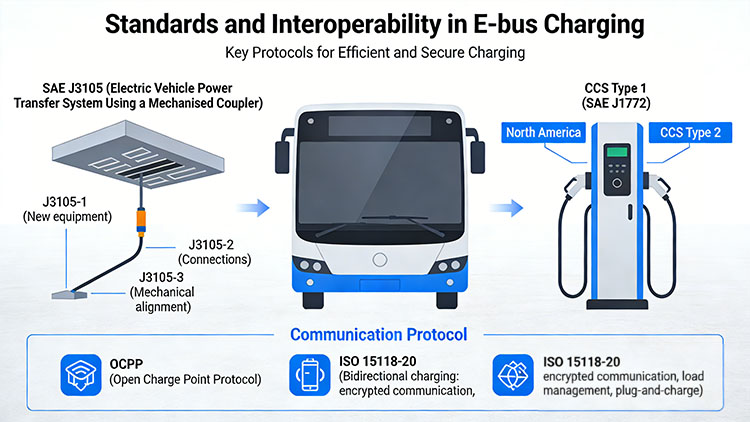
Unlike passenger EV charging, where multiple connector standards still compete, e-bus charging is increasingly coalescing around a few interoperable protocols. The SAE J3105 standard (Electric Vehicle Power Transfer System Using a Mechanised Coupler) governs overhead conductive charging, with supplements J3105-1, -2, and -3 allowing for new equipment, connections, and mechanical alignment. For plug-in charging, CCS Type 1 (SAE J1772) is widely adopted in North America, while CCS Type 2 dominates in Europe. Many systems support OCPP (Open Charge Point Protocol) communication for optimized load management and remote monitoring.
The ISO 15118-20 standard is particularly important for bidirectional charging, as it supports encrypted communication, load management, and plug-and-charge functionality without requiring RFID cards or mobile apps.
Fleet Charging Infrastructure: Depots as Energy Hubs
A bus depot undergoing electrification becomes one of the largest electrical loads in a city district. A typical electric bus depot includes:
High-capacity grid connection with dedicated transformers and switchgear
Multiple charging points arranged for safe vehicle flow, often in drive-through bays
Robust cable management and vehicle clearance planning
Zoning and redundancy so a single fault does not disable the entire depot
Operational signage and dispatch rules to prevent congestion
Power management is central. Depots enforce site power caps to avoid demand spikes and circuit trips, implement priority rules based on departure times and required kilowatt-hours, balance loads across many buses charging simultaneously, and coordinate with building loads and depot operations.
The planning challenge is substantial. For the St. Louis Metro, engineers had to build a dedicated substation to support depot power requirements—a process that can take years between acquiring land, zoning approval, procuring equipment, and construction. Without careful planning, the simultaneous return of all buses to the depot at the end of service can create massive power spikes that overwhelm local grid capacity.
Smart Charging and Energy Management
Modern e-bus charging is as much about software as hardware. A robust control stack typically includes:
CPMS (Charge Point Management System) for monitoring, alarms, and basic control
Depot scheduling integration linking timetables, bus assignments, and state-of-charge targets
Reporting on energy per route, cost allocation, and readiness rates
Maintenance workflows for fault triage, spare parts, and service SLAs
Cybersecurity for device identity and secure remote updates
Dynamic load management spreads available power to the bus that needs it most, prioritizing operational needs while reducing the burden on the grid. By charging buses during off-peak hours and using smart algorithms to balance loads, depots can avoid expensive demand charges and operate within constrained grid capacity.
The Business Case: Ownership and Deployment Models
E-bus charging infrastructure requires significant upfront investment, but a range of business models is emerging to spread costs and risks.
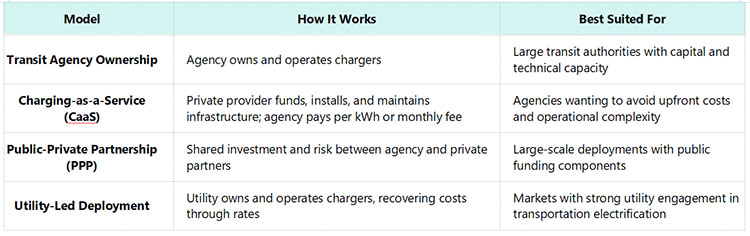
Charging-as-a-Service models are gaining traction, enabling operators to transfer operational complexity to specialized providers while locking in performance service levels and predictable lifecycle costs. Procurement processes are evolving to value total cost of ownership and uptime guarantees rather than purely upfront capital costs.
Global Market Outlook
The electric bus charging infrastructure market is on a steep growth trajectory. The global market size was estimated at approximately USD 2.21 billion in 2024. Forecasts vary by source, but all point to robust growth:

The Asia-Pacific region accounts for the largest market share, driven by China's integrated bus charging depots—setting global benchmarks for efficiency—and India's PM-eBus Sewa scheme, which aims to deploy over 10,000 electric buses in 169 cities. Europe follows closely, with new electric bus registrations in the European Union rising by 28.7% in the first nine months of 2024 compared to the prior year. North America is witnessing increased adoption through federal Low-No Emissions grants, which include infrastructure development as a core funding area.
Key players in the e-bus charging ecosystem include ABB, Siemens, Proterra, BYD, ChargePoint, Heliox (by Siemens), and Hitachi Energy.
Challenges and Considerations
Despite the compelling case for electrification, significant challenges remain.
Grid Capacity and Infrastructure Upgrades: Many existing electrical networks require complex and costly upgrades to sustain the high power loads required for simultaneous fleet charging. In markets like India, where fleet electrification is advancing rapidly, operators face frequent voltage fluctuations and supply gaps. Building substations can take years, requiring land acquisition, zoning approval, equipment procurement, and construction.
High Upfront Capital Costs: Depot electrification is capital-intensive. Proterra's high-power charging solution for on-route charging has been estimated at approximately $600,000 per station per route, compared to BYD's depot-based slow-charging approach at roughly $6,000 per station. While costs are declining, the upfront investment remains a barrier for many transit agencies.
Operational Complexity: Electric bus depots become some of the largest electrical loads in a city district. Managing simultaneous charging of dozens or hundreds of buses requires sophisticated software controls, redundancy planning, and specialized technician training for high-voltage systems.
Standardization Gaps: While standards like SAE J3105 and ISO 15118-20 are advancing, wireless high-power charging standards remain under development, creating uncertainty for long-term investments.
Common Planning Pitfalls: Industry experience has identified recurring mistakes: designing only for average days rather than peak service days and cold-weather conditions; underestimating simultaneity at depot return times; failing to plan phased expansion (duct banks, spare switchgear capacity); installing too few high-priority bays for recovery charging; neglecting connectivity in large yards and garages; and insufficient redundancy and spare parts leading to extended outages.
Future Trends and Innovations
The e-bus charging landscape is evolving rapidly, with several transformative trends shaping the next decade.
Vehicle-to-Grid (V2G) and Bidirectional Charging: Electric bus batteries are among the largest mobile energy storage assets in any city. Through V2G technology, fleets can charge during low-demand periods and discharge stored energy back to the grid during peaks. The London "Bus2Grid" project uses 28 BYD double-decker buses capable of returning over 1 MW of power to the grid. In the United States, Hubject, Heliox, Accelera by Cummins, and Blue Bird announced the first commercial deployment of a V2G charging solution complying with ISO 15118-20, centered on electric school buses. This creates new revenue streams for transit agencies while supporting grid resilience.
Wireless Charging at Scale: The Federal Transit Administration has tasked CALSTART with assessing the viability of wireless charging for battery electric buses, exploring its potential as both a primary charging solution and a range extender. InductEV's wireless system, already deployed across multiple US transit fleets, delivers up to 450 kW of hands-free power.
Renewable Integration and Microgrids: Integrating renewable energy into e-bus charging infrastructure is emerging as a critical priority. Shenzhen, home to the world's largest electric bus fleet, has equipped its depots with rooftop solar arrays, significantly reducing dependence on coal-based grid electricity. The Los Angeles Department of Transportation selected Proterra and Apparent to install a solar and storage microgrid paired with 104 EV chargers at its Washington Bus Yard. In California, the Innovative Clean Transit initiative encourages operators to combine solar generation with battery storage.
AI-Driven Charging Optimization: Artificial intelligence is increasingly used to optimize charging schedules based on real-time energy prices, grid conditions, weather forecasts, and vehicle departure times. Integrated optimization frameworks now jointly consider charging infrastructure deployment, bus scheduling, and renewable energy integration to minimize total system costs.
Battery Swapping: An alternative to conventional charging, battery swapping replaces depleted battery packs with fully charged units at dedicated swap stations—a process completed within minutes, significantly faster than conventional charging. While more common in China for two-wheelers and some commercial vehicles, the approach is being explored for bus fleets in markets with standardized battery designs.
Key Performance Indicators (KPIs) for E-Bus Operations
 for E-Bus Operations ") for E-Bus Operations ") for E-Bus Operations ")
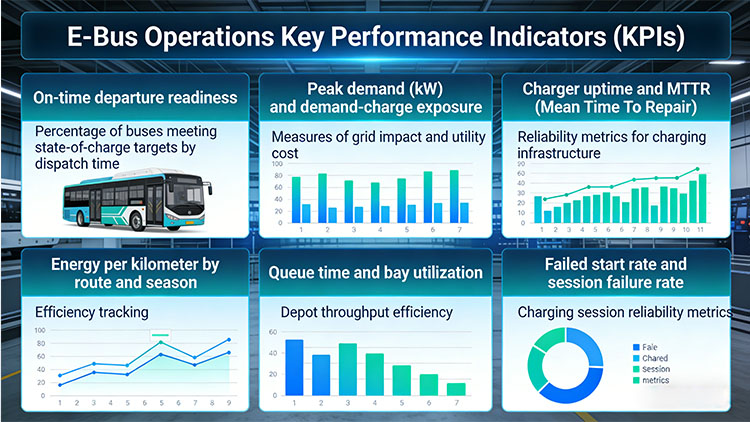
Transit agencies track specific metrics to ensure reliable and cost-effective e-bus operations:
On-time departure readiness: Percentage of buses meeting state-of-charge targets by dispatch time
Peak demand (kW) and demand-charge exposure: Measures of grid impact and utility cost
Charger uptime and MTTR (Mean Time To Repair): Reliability metrics for charging infrastructure
Energy per kilometer by route and season: Efficiency tracking
Queue time and bay utilization: Depot throughput efficiency
Failed start rate and session failure rate: Charging session reliability metrics
Conclusion
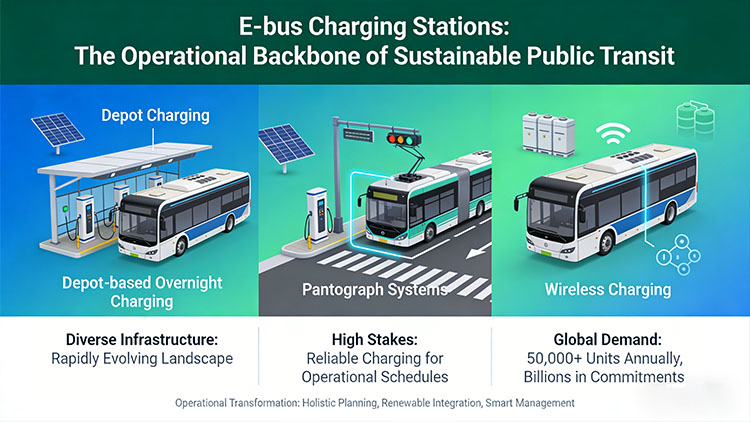
E-bus charging stations represent far more than a place to plug in a vehicle—they are the operational backbone of sustainable public transit. From depot-based overnight charging to pantograph systems at busy intersections and emerging wireless technologies, the infrastructure landscape is diverse and rapidly evolving. The stakes are high: without reliable charging ecosystems, electric buses cannot meet operational schedules, particularly on high-frequency urban routes.
With global electric bus sales approaching 50,000 units annually and governments from India to the United States committing billions to fleet electrification, the demand for robust, scalable, and smart charging infrastructure has never been greater. The transit agencies that succeed in this transition will be those that plan holistically—balancing depot charging with on-route solutions, integrating renewable energy and storage, adopting smart load management, and embracing new business models that transfer operational complexity to specialized partners.
The electrification of bus fleets is not merely an environmental imperative; it is an operational transformation. And at the heart of that transformation lies the e-bus charging station—quiet, powerful, and indispensable.